Benchmark Design
AM-Bench factorizes aerial manipulation into modules that can be changed independently while retaining shared tasks and evaluation outputs.
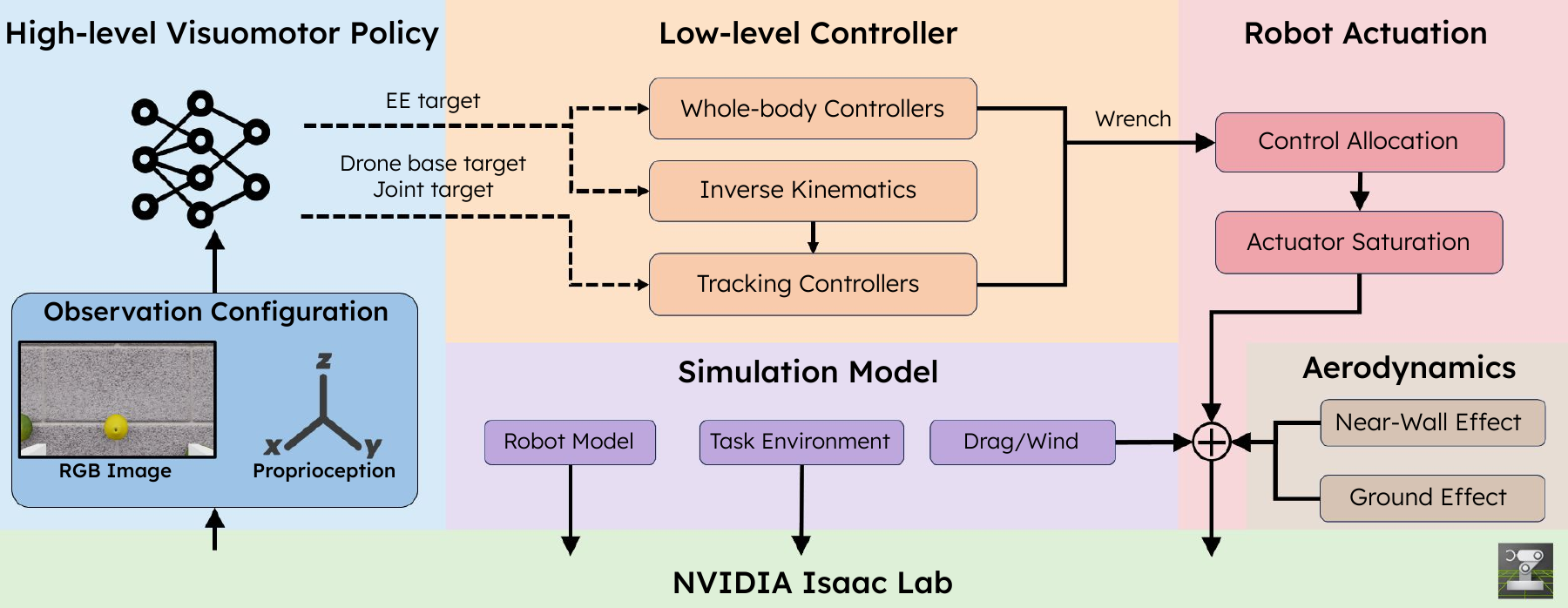
Five configuration axes
Task environment
Tasks define scene geometry, manipulated objects, reset randomization, success conditions, subtasks, and episode limits. The current suite spans instantaneous interaction, object transport, and constrained-contact skills.
Robot platform
Robot profiles combine an articulation, rotor layout, manipulator and gripper semantics, camera placement, action pipeline, and controller. The physical platforms cover underactuated, fully actuated, and overactuated multirotors.
High-level policy
Policies consume configurable RGB and proprioceptive observations. They output either an end-effector target or an absolute base-plus-joint target. Scripted policies and learned policies share the same environment action boundary.
Low-level control
End-effector targets can pass through decoupled inverse-kinematics and tracking controllers or through whole-body MPC. Base-plus-joint targets bypass inverse kinematics and directly specify the configuration tracked by the low-level controller.
Physics and actuation
Control allocation maps body wrench commands to rotor thrusts. The simulation can apply physical saturation, reduced-order actuator response, ground effect, near-wall effect, drag, wind, and sensor or command noise.
Controlled comparisons
The modular split supports comparisons that would otherwise conflate multiple causes. For example, the same task and learned policy can be evaluated with different low-level controllers, or the same end-effector command can be resolved on multiple embodiments. Tracking and limit-use metrics help explain why two runs with similar task success may use the platform differently.
Use Policy-Control Interfaces for the command paths, Physics and Disturbances for force application order, and Evaluation Outputs for the recorded diagnostics.